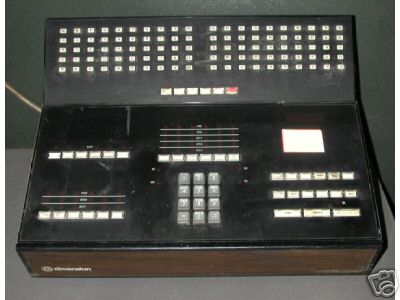
Today’s Phone of the Day is a retake of the CallMaster IV terminal for the use of Avaya enterprise grade PBX systems. These are not telephones, and they are not attendant consoles and while there is an apparent resembelence of the Call Director, these sets would not be used for “answering centers” since Voice mail had taken many of those roles anyways.
You thought Avaya would be off the hook (non pun intended) right?
Nope! It would defeat the purpose of being the equal opportunity offender.
Dimension Attendant Console, circa mid 1970s. NOT MY IMAGE.
This console was made in the early 1970s for the Bell System’s Dimension PBX (and smaller versions most likely for the Horizon system.) The console was a weird design consisting of a shoebox form factor.
To the right of the set had only eight characters alpha numeric LED display. The console is filled with many indicators (the design at the time.) The console was very primitive for it’s time. No call appearances for overflowed calls. The buttons above the dialpad did act as such but they were referred (IIRC) as loopback lines.
Even stranger, as with many consoles at the time, would require a straight up, direct line from a special console port on the PBX to the location of the console. What was it’s connector? You guessed it, a 25 pair Amphenol plug!
While the Dimension console did in fact have BLFs with buttons, it was a seperate option and was located on the top, picture shown above.
Not My Photo – Same Crappy Set a with new Look! (and more BLFs since the System 85/Definity G2 could support to over 30,000 extensions on a single node!)
In the mid to late 1980s, AT&T remade the set – took away the wood grain decal, mainstream of office telephones of the time, and made it jet black, to match the Merlin-like sets of the time as this console went into System 85 PBX line. If research confirms my out of experience of that PBX, the only attendant console, had to be one that was hard wired to the PBX. Unless with some reversed engineering, and some creativity, one could theoretically take AT&T’s ISDN console that was identical to the 302s, put it as an ISDN set and do it that way.
The Definity G3r succeeded the System 85/Definity G2 (aka a band-aid Dimension) in the mid 1990s. Release 5 was intended to be the combination of the 2 PBX systems, after all it’s core roots dates back to when the Bell System marketed the thing. Of the many fundamental changes, what retained were desksets, carriers, etc.; what went away was some of the user interfaces, the notorious MAAP to program the system, and the hardwired attendant console. A 302 could replace it via a 2 wire (2 pair if you wanted power coming out of the wall’s) voice drop and be affiliated in a DCP line over a dedicated attendant port. The only set that would continue with button caps at this point in the late 1980s lead into the 302 set to have similar clear plastic overlay for designation keys.
It’s strange the console given its “electronic” ability, could very well be mistaken for being some electrical box like an ol Call Director or 10 to 30 line set.
It’s one of those “I so just don’t want to remember this set”
I proudly admit I am an AT&T brat. I was born 3 years after the Divesture, so my bias is strong since I never witnessed the old monopoly. Everyone in my crazy life knows how I live and pray upon any of the equipment coming from the old AT&T and its zillions of spinoffs since.
I’d still give these systems a strong plug even when Avaya has essentially taxed companies with excessive License and Right to Use dues, as Cisco has been known to do. If you can afford it, its the best. It’s the Rolls Royce of phone systems.
In the late 80s (just probably before 1990, when they renamed their systems), AT&T ran an ad campaign actually running commericals of their enterprise PBX systems, known at the time Systems 75 and System 85. (System 25 was built upon the Merlin code so its ilrelevent for that reference.) The System 85 was built upon code from the Dimension PBX that was made by Western Electric, and was distributed by the Ma Bell’s operating companies for businesses to lease. The System 75 was based on fully on digital telephony, the ability to use ISDN, the ability to interoperate computer mainframes and run cables on the same line as the dummy terminals. The System 75’s code and its hardware would lead into the 90s and into the last and present decade, with its 16th revision known as Avaya Aura V.6.
In this commercial a train goes into the air, as the announcer says mentions how a communications system “can expand and expand” and ends with
“A new communications system so advance, its litterly impossible to outgrow.”
The Definity name is a contraction of “Definitive Solutions for an Infinite Amount of Possibilities” that Lucent touted in the late 90s on their respected product page.
However after the spinoff from Lucent’s Enterprise Networks division, that became of Avaya, they ruined the name by calling the newer versions of the Definity system after Release 10 “Communication Manager” to “Aura” (which I still am not sure how to pronounce) and maybe in a few years will be another odd name, as Avaya slowly became a modernist, fancy, over stylish company.