AT&T (nee SBC, nee Southwestern Bell) dropped a story Friday evening while some of the East Coast was disrupted by the DDOS attack that they had intentions to acquire Time Warner, the owner of CNN (the Cheap News Network), HBO, Warner Pictures, etc. for about $85 billion dollars.
Of course, this is subject to approval by the Federal Communications Commission, and similar to the NBCUniversal/Comcast acquisition from GE in 2010; expect concessions and terms of sale to also follow.
This deal however, does not include Time Warner Cable (historically branded for it’s Road Runner triple play services) which was spun off several years ago, but kept the name and the “sight and sound” logo.
On this 15th anniversary of the most horrific and atrocious day in American history, your humble Curator would like to dedicate this day with the AT&T’s mini documentary of the construction of the World Trade Center around 1976 and the installation of switching systems. This video has been embedded in past posts around 9/11, but as a duty to remember, I am posting this again.
I hope you enjoy your day, remembering the day with some grief with happiness of being alive and (if you’re old enough) reminiscing of enjoying life before our world became vigilant of terror.
Here are some pictures sent to me by one of my followers who asked to not be identified by name, but with this tight community, does everyone need to be identified everytime, all the time? 🙂 I did get permission to post these, and I want to keep the descriptions to a minimum. If you are accessing this from the home page, click to read more.
Every year the Museum will remember 9/11 until I die or the site dies, whatever comes first.
It’s something we cannot forget, because sadly people are forgetting and our children have no idea, and some people as young as 25 year olds are confused to see a New York once up in smoke and can’t understand how people fell out of the Twin Towers to escape the hell or go into hell, depending on how you look at it.
The Twin Towers had cheated disasters before. The bombings in February of 1993 impacted a lot more people, because each tower could hold up to 50,000 people of workers, visitors, travelers, etc. On the morning of 9/11, Lower Manhattan was considered very lucky compared to 1993, given it was a late summer day, a Yankees game went into extra innings due to a rain delay and people deciding to show up at work at 9:00 instead of 7 or 6 in the morning made the death count much lower than what could’ve been.
(In the 1993 bombings, the bombers tried to hit one of the 4 corners of the towers, and supposedly if they had hit one of the corners of the towers, it could loose it’s integrity immediately. Lower Manhattan was lucky too, as the bombers missed their target.)
Regardless between the three coordinated attacks, over 3,000 people died. AT&T, which was mostly an LD, data transport and cable TV services did not loose any of their workers, while other engineers did loose life.
According to AT&T, the switching system used in 2001, mostly of 5ESS or possibly DMS switching systems remained in tact. In fact because the switching systems were in a vault, the services (at least wired connections) could’ve worked if it wasn’t the wiring getting severed by the atrocious damage of the towers.
In the early 1970s, AT&T produced a video of the construction of the World Trade Center, and installation of switching equipment at the time (albeit an earlier generation of an ESS) and the days that followed with a typical business day in the Twin Towers. This film was released in 1976
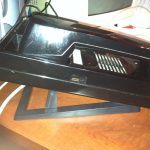
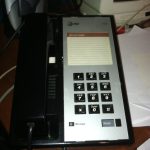
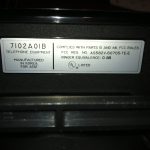
Here is another private collection of another office telephone. It’s an AT&T (now Avaya) 7102 Analog telephone.
These were made by AT&T in the mid to late 80s, sports the “R” handset (Merlin style) while having a basic featureset with a 12 digit dial pad and a “Recall” (read: Flash) to use additional features of the PBX or “Call Waiting” as this terminal can – in fact – be used for residential landline services.
In fact, the ringer is much like the very old AT&T 1810 digital answering machine/house phone I had at my family’s house. It doesn’t have the sound of the digital telephones unfortunately.
I bought this on eBay a while back, and here is the gallery
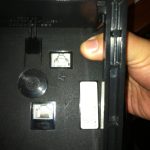
It was made in Korea, kinda odd for phones to be made out of the States at that time. Maybe this was built in the same plant as the other consumer phones that AT&T continued to produce leading to the spinoff to Lucent in 1996. I opened the phone and the guts looked like a cheap Asian produced device.
This phone however, is a shell of a BIS-10 (or a 7410 Plus), take the DESI paper off, and you’ll see the empty spots for those buttons. It was kinda surprising to see, but I guess since there was a membrane cover, it didn’t matter. I’ll post that picture (and redo the picture gallery in a neater workspace) at a later time.
I proudly admit I am an AT&T brat. I was born 3 years after the Divesture, so my bias is strong since I never witnessed the old monopoly. Everyone in my crazy life knows how I live and pray upon any of the equipment coming from the old AT&T and its zillions of spinoffs since.
I’d still give these systems a strong plug even when Avaya has essentially taxed companies with excessive License and Right to Use dues, as Cisco has been known to do. If you can afford it, its the best. It’s the Rolls Royce of phone systems.
In the late 80s (just probably before 1990, when they renamed their systems), AT&T ran an ad campaign actually running commericals of their enterprise PBX systems, known at the time Systems 75 and System 85. (System 25 was built upon the Merlin code so its ilrelevent for that reference.) The System 85 was built upon code from the Dimension PBX that was made by Western Electric, and was distributed by the Ma Bell’s operating companies for businesses to lease. The System 75 was based on fully on digital telephony, the ability to use ISDN, the ability to interoperate computer mainframes and run cables on the same line as the dummy terminals. The System 75’s code and its hardware would lead into the 90s and into the last and present decade, with its 16th revision known as Avaya Aura V.6.
In this commercial a train goes into the air, as the announcer says mentions how a communications system “can expand and expand” and ends with
“A new communications system so advance, its litterly impossible to outgrow.”
The Definity name is a contraction of “Definitive Solutions for an Infinite Amount of Possibilities” that Lucent touted in the late 90s on their respected product page.
However after the spinoff from Lucent’s Enterprise Networks division, that became of Avaya, they ruined the name by calling the newer versions of the Definity system after Release 10 “Communication Manager” to “Aura” (which I still am not sure how to pronounce) and maybe in a few years will be another odd name, as Avaya slowly became a modernist, fancy, over stylish company.